
The Ood Ball (also known as the Holy Hand Grenade) is back! Why would I be so excited about having this thing attached to me for 48 hours? Because it’s not the pink pills from before that caused so much trauma/drama for us last time. Also, that fanny pack holding the Ood Ball is a great accessory these days.
Time for a quick vocabulary lesson, starting with my chemo cocktail. My treatment is known as FOLFOX + Beva.
- FOL: Folinic Acid: Reduces side effects and adds protection to healthy cells
- F: Fluorouracil (aka 5-FU) (aka 5-F$@# yoU): Causes cancer cells to starve to death. It takes thymine out of the cell’s diet, but scientists are still figuring out why cells die without thymine.
- OX: Oxaliplatin: Sticks to the cancer cell and prevents it from making copies of itself.
- Beva: Bevacizumab (aka Avastin, Zirabev, Mvasi) (aka Beelzebub): Prevents new blood vessels connecting to cancer cells. New blood vessels allow cancer to metastasize (move to other parts of your body). Beelzebub wasn’t a part of my previous Ood cocktail because it was still in the original organ.
It looks like algebra, so let’s do some factoring to cover the duration. Just remember Please Excuse My Dear Aunt Sally. [(Beva x 30 minutes) + (FOL + OX) x 2 hours] + F x 48 hours I also get a small pill (that isn’t pink) of 5-FU before the infusion.
Now we can talk about balls. Medical pros refer to them as elastomeric pumps or balloon pumps, but patients come up with the best nicknames. (In putting this together, I realized for the first time that the Holy Hand Grenade is made out of a small coconut. The more you know!)
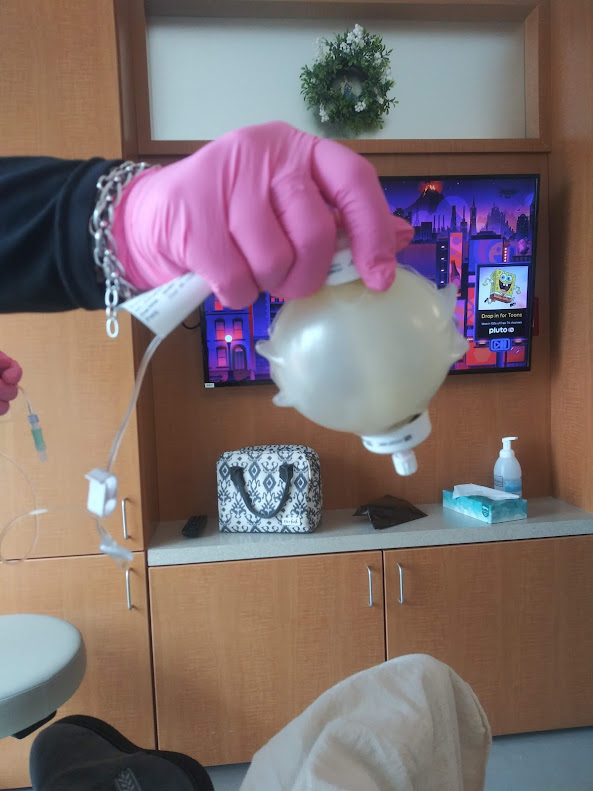



Mine is about the size of a softball when it’s first attached and holds 5-FU. It’s more effective when it’s injected very slowly, milliliters at a time. It’s fully deflated after 48 hours. Chemo balls allow patients to finish infusions anywhere rather than being stuck at the hospital until it’s complete. It’s also a win for oncology teams since it frees up space and time to help even more patients.
My favorite part is how the medicine gets from the ball or IV drip to my body. My veins were miserable after the two rounds of pink pills. Trying to attach a line the traditional way only led to bruises. Nurses today have issues finding a good vein in my wrists or hands which means they still haven’t recovered. This is why chemo patients often have what’s called a port.
Imagine the squeaky part of a squeaky toy being surgically placed under your skin and connected to a vein close to your heart. It acts as a reservoir that a needle and IV line can connect directly to. Medicine can be injected into the port and blood can be drawn from it. Anything a regular IV line can do it can do better.
Going home with the Ood Ball doesn’t mean I wheel an IV drip everywhere. Once it’s connected to my port, the ball sits in a fanny pack on my waist while my heart does all the work, pumping it into my bloodstream slowly and steadily.

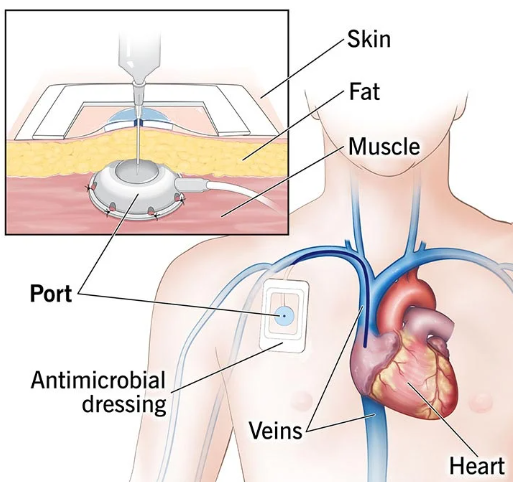

It can be awkward for some people and takes some getting used to, but mine has never given me issues. The one downside is the upkeep. Every month I have to get it flushed with saline and heparin to prevent infection and clotting. Ports require a special kind of needle that your neighborhood clinic doesn’t keep in stock. They have to be flushed every time they’re accessed and disconnected, so each needle comes with a full kit including the saline and heparin syringes, gloves, and disinfectant supplies. If you have large hands, the kit only has one size. (Poor Greg. He tried his best even while his hands lost circulation.) I’ve used it a handful of times for CT scans and one surgery between April 2021 and July 2023. Personally, I love it, but it’s not a great long-term option for everyone.
Knowing how things work, especially where medical concerns are involved, reduces my anxiety. Learning just these basics has made living with cancer more interesting and less terrifying. What’s that phrase? Know thy enemy?
 Team Hedgehog